
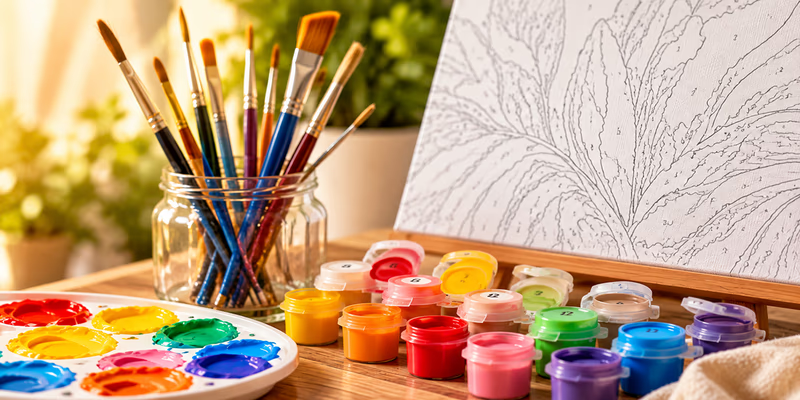
Which paints and brushes to choose for paint by numbers
A ready-made paint-by-numbers kit usually includes paints and brushes — but sooner or later, many people wonder: should I buy a missing shade, replace a brush that quickly frayed, or even assemble materials myself for a pattern created in the generator? In this article, we’ll break down which paints work best, how gouache differs from acrylic specifically for this technique, and how to choose brushes that won’t ruin the small details of the scheme.
Which paints to use for paint by numbers
Several types of paint are suitable for painting by numbers, and the choice largely depends on what you already have at hand and the size of the details on your specific pattern.
Acrylic paints
The most common option — acrylic is what comes in most ready-made paint-by-numbers kits, and for good reason:
- Dry quickly — you don’t have to wait hours between layers, which is especially important when zones on the pattern are close to each other.
- Water-resistant after drying. Your finished painting won’t smudge if water drops accidentally hit it.
- Provide good coverage — even in light areas, the dark outlines of the pattern won’t show through the paint if applied in two layers.
- Easy to mix, which is convenient if you need to find an intermediate shade not included in the kit.
The downside of acrylic is that it dries quite quickly not only on the paper but also on the brush and in an open jar. If you take breaks between painting sessions, be sure to close the paint lids and keep the brushes moist while you work.
Gouache
Gouache is also suitable for paint by numbers, especially if you already have a set at home:
- Provides a more matte, velvety finish compared to acrylic.
- Stays wet longer on the palette, which is convenient for mixing shades without rushing.
- Generally cheaper than acrylic for a comparable volume.
The main disadvantage is that gouache is less moisture-resistant even after drying and may crack slightly if applied too thickly on small details. For large zones, this isn’t critical, but for very small elements, it’s better to use acrylic.
Ready-made sets vs. individual tubes
If you are buying paints for a specific pattern, there are two approaches:
- A basic set of primary colors (12-24 shades) — more economical, but you’ll have to mix some of the required colors yourself.
- Individual tubes for specific shades from the palette — more accurately matches the scheme but is more expensive, especially if the palette has 20+ unique colors.
A practical middle-ground is to get a basic set with primary colors (white, black, red, yellow, blue, and a few extra shades) and mix the missing colors yourself. To avoid guessing proportions, PaintByNumbers has a paint matching tool — you enter the HEX code of the desired color from the scheme (or pick it directly from the generator palette), and the service calculates the exact recipe: how much of which basic pigments to mix to get the desired shade.
Which brushes are needed for painting by numbers
Brushes are just as important as the paints: a brush that is too wide or stiff will ruin small details even with the correctly matched color.
Size and shape
For most patterns, 3-4 brushes of different sizes are sufficient:
- Thin brush (size 0-2, round) — for small details, zone boundaries, and areas where multiple colors meet.
- Medium brush (size 4-6, round or flat) — for the bulk of the work and medium-sized areas.
- Wide flat brush (size 8-10) — for large solid areas and backgrounds, so you don’t waste time filling large spaces with a small brush.
Round brushes are better for detailed areas and small outlines, while flat brushes are better for smooth coverage of large uniform areas without streaks.
Bristle material
- Synthetic bristles — the optimal choice for acrylic and gouache. They don’t absorb as much paint as natural hair, are easier to clean, and hold the shape of the tip longer when working on small details.
- Natural hair (sable, squirrel) — better suited for watercolors and thin glazing; for thick acrylic or gouache, it’s overkill and wears out faster.
For paint by numbers, synthetics are a practical choice in almost all cases: they are cheaper, and the result with opaque paints like acrylic or gouache is just as good.
What to look for when buying
- The tip of the brush should hold a sharp point even after a light press — if the bristles immediately “fringe,” it will be difficult to paint the small details of the scheme.
- For long work sessions, brushes with wooden or rubberized handles are more comfortable — thin plastic handles cause hand fatigue faster during long painting sessions.
- You don’t need to buy an expensive set of professional brushes — entry or mid-level brushes are perfectly adequate for paint by numbers; durability is more important than premium hair.
Brush and paint care between sessions
If your painting stretches over several days, a few simple rules will prolong the life of your materials:
- Rinse brushes immediately after each session before the paint dries in the bristles — dried acrylic is almost impossible to wash out.
- Keep paints tightly closed. If acrylic starts to dry in the jar, you can add a little water to restore a working consistency.
- Write down your custom-mixed shades (for example, following recipes from the paint matching tool) — record the proportions and the name of the resulting color so you can recreate it the next day if needed.
FAQ
Acrylic or gouache — which is better for paint by numbers?
For most patterns, acrylic is more convenient because it is moisture-resistant after drying and better suited for small details. Gouache is a good budget option, especially for schemes with large areas.
How many brushes do I need for one painting?
Usually, 3-4 brushes of different sizes are enough: thin for details, medium for general work, and wide for large areas.
Can I avoid buying extra paints if a shade is missing?
Yes, in most cases, you can mix the desired shade from a basic set. The PaintByNumbers matching tool calculates the exact mixing proportions for a specific color from your palette.
Are brushes from standard craft kits suitable?
Yes, you don’t need professional art brushes for paint by numbers — entry or mid-level synthetic brushes of the right sizes are sufficient.